

AdBlue fluid helps reduce pollutant emissions from new diesel vehicles. AdBlue is an aqueous solution composed of 32.5% synthetic urea and 67.5% demineralized water.
In practice, this colorless and biodegradable liquid is sent into the exhaust pipe where a chemical reaction called selective catalytic reduction (SCR) takes place.
This technique, long used in the treatment of industrial polluting emissions, has been transferred to trucks to meet Euro 5 pollution levels, and now to light vehicles to meet Euro 6.
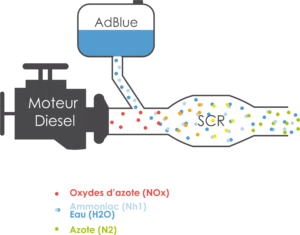
Under the effect of heat, urea is transformed into carbon dioxide and ammonia.
Inside the catalytic converter, a chemical reaction occurs between ammonia and nitrogen oxides emitted by the engine. This produces water vapor and nitrogen, which are considered harmless gases.
Where is the AdBlue tank located?
AdBlue should never be mixed with diesel fuel; it has its own dedicated tank. This tank is usually located next to the fuel tank and is distinguished by a blue cap.
It may also be under the hood or in the trunk near the spare tire well, again with a blue cap and the word "AdBlue."

AdBlue containers are sold in automotive shops. Some service stations are equipped with AdBlue pumps, but these are often located at the truck pumps, resulting in a flow rate that is too high for cars.
Some information
AdBlue has been available since September 2014 for diesel vehicles and agricultural and construction machinery to meet the Euro 6 standard. This standard aims to improve air quality, while SCR technology meets the Euro standard objectives for light vehicles, but has been required for heavy goods vehicles for over 10 years.
All new vehicles are affected by this standard (exclusively diesel engines with more than 50 horsepower until the end of 2019 and all engines with more than 30 horsepower from 2020 onwards).
Point of vigilance
What happens in case of a breakdown?
When the AdBlue warning light appears on the dashboard, the remaining range is on average 2,400 kilometers before running out of fuel.
This warning should not be ignored, as the engine may go into limp mode and cause the vehicle to stop completely, requiring a mechanic to restart it. The AdBlue level can be checked at a garage upon presentation of your FATEC card for payment and billing.
AdBlue does not keep for long, as the product degrades. Therefore, it is generally sold in 1/5 or 10-liter containers at auto parts stores or gas stations for immediate use.
AdBlue contains corrosive elements. Avoid all contact with skin and clothing.

Some figures
On average, the AdBlue tank volume has a capacity of 15L to 20L depending on the car model.
For a heavy goods vehicle, AdBlue consumption is approximately 5 to 7% of the diesel fuel used. The tank capacity is approximately 30 to 50 liters .
A can of AdBlue costs on average €10 for 5 litres .