

The objectives of the LOM Law, the quotas for clean vehicles in fleet renewals, the installation of charging stations, the Company Mobility Plan, the sustainable mobility package, the mobility voucher and the ZFE-m, you will know everything about the LOM Law!
The objectives of the LOM 2022 law
The Mobility Orientation Law (or LOM) aims to bring about a profound transformation in the daily mobility of all citizens. This translates into more efficient, cleaner, and more accessible transport solutions.
Specifically, when talking about company car fleets, the objectives of the LOM are as follows:
- Gradually reduce the use of polluting vehicles by replacing them with cleaner vehicles
- Facilitating commutes by reducing dependence on individual car use
- Encourage travel by bicycle, scooter, on foot or carpooling with a bonus of up to €600/year (Sustainable Mobility Package, Mobility Voucher )
The Climate and Resilience Law ( published in the Official Journal on August 24, 2021 ) has tightened the LOM on quotas for clean vehicles.
As a reminder, the Mobility Orientation Law was published in the Official Journal on December 26, 2019. This law profoundly transforms mobility policy, with a simple objective: everyday transport that is easier, less expensive and cleaner.
Clean vehicle quotas for companies with more than 100 vehicles
The text specifies that the companies concerned are " companies which manage directly or indirectly, as part of their activities in the competitive sector, a fleet of more than 100 motor vehicles whose total authorized weight is less than or equal to 3.5 tonnes ."
The fleet size (>100 vehicles) to be considered is that of all the company's establishments and subsidiaries located in France.
Currently, there are no penalties for non-compliance with this rule.
- 2022: 10% low-emission vehicles* in company car fleet renewals
- 2024: 20% LOW-EMISSION ENGINES* IN COMPANY FLEET RENEWALS
- 2027: 40% LOW-EMISSION ENGINES* IN COMPANY FLEET RENEWALS
- 2030: 70% LOW-EMISSION* ENGINES IN COMPANY FLEET RENEWALS
- 2035: COMPLETE DISAPPEARANCE OF INTERNAL COMBUSTION ENGINES IN VEHICLE SALES
Understanding the obligations for public actors
According to article L224-8 and for vehicles with a total laden weight ≤3.5 t:
Regarding the State and its public institutions that manage (directly or indirectly) a fleet of more than 20 vehicles for activities not belonging to the competitive sector:
- 30% of vehicles are currently low-emission*
- 50% low-emission vehicles* by December 31, 2026 and 70% from January 1, 2027
- 37.4% of ultra-low emission vehicles** from January 1, 2026 to December 31, 2029
- 45% of vehicles will be ultra-low emission vehicles** by January 1, 2030
Regarding local authorities, their groupings and their public establishments which manage (directly or indirectly) a fleet of more than 20 vehicles for activities not belonging to the competitive sector:
- 30% of low-emission vehicles* by December 31, 2024
- 40% of low-emission vehicles* from January 1, 2025 to December 31, 2029
- 70% of vehicles to be low-emission* by January 1, 2030
- 37.4% of ultra-low emission vehicles** from January 1, 2026 to December 31, 2029
- 40% of vehicles with very low emissions** from January 1, 2030
45% of vehicles with very low emissions** from January 1, 2030.
Regarding other contracting authorities and contracting entities:
- 40% of low-emission vehicles* from January 1, 2022
- 37.4% of ultra-low emission vehicles** from January 1, 2026 to December 31, 2029
*Low-emission vehicle (LVE) : Passenger car or van whose CO² emissions do not exceed 50 gCO2/km according to Article D224-15-11 of the Environmental Code.
**Very low-emission vehicle (VTFE) : Passenger car, van, two- or three-wheeled motor vehicle or quadricycle whose energy source is: electricity (EL), hydrogen (H2), hydrogen-electric [plug-in hybrid] (HE); hydrogen-electric [non-plug-in hybrid] (HH) or compressed air (AC) according to Article D224-15-12 of the Environmental Code.
Public charging points
100,000 charging points must be open to the public by 2022.
As of February 28, 2022, 55,515 were open to the public in France, representing a 53% increase over 12 months according to Avere , the national association for the development of electric mobility.
By 2030 , the government aims to install 7 million public and private charging points (compared to 612,000 currently).
The installation of charging stations is mandatory in car parks with more than 10 spaces in new or renovated buildings.
In businesses, the pre-equipping and installation of charging stations is mandatory and can affect at least 5 to 10% of parking spaces, depending on the population of the urban area. This legal obligation applies to parking lots at buildings used for office or industrial purposes, public services, shopping centers, and cinemas.
Financial assistance is available for the installation of electric vehicle charging stations, whether for individuals, businesses, or local authorities: the Prime Advenir grant . Businesses can receive funding of up to 60% of the installation costs for electric vehicle charging stations and 80% for upgrading an existing charging point.
FATEC Group helps companies identify vehicles that can be replaced by EVs and deploys charging infrastructure on-site or at home.
Get support
The Employer Mobility Plan
The Employer Mobility Plan (PDME), formerly the Company Travel Plan (PDE), is a genuine company project promoting the use of alternative modes of transport to the individual car, and is governed by the Mobility Orientation Law (LOM).
Companies required to implement an Employer Mobility Plan . The law then requires the company to conduct a mobility assessment and subsequently present the action plan implemented.
How to create an Employer Mobility Plan?
The development of the Employer Mobility Plan can take from 6 to 12 months, during which 4 stages are addressed:
- Diagnosis: Employee travel practices, site accessibility and services
- Action plan: Identify the most relevant actions to implement, budget, timeline, resources, communication strategy and consultation.
- Implementation: Carry out the actions, deploy the appropriate tools
- Evaluation: Monitor the implementation of actions, evaluate the success of the program and employee satisfaction
The Sustainable Mobility Package

The Sustainable Mobility Package (or FMD) is a scheme established by the Mobility Orientation Law that allows employees to benefit from financial assistance from their employer for their commute. The Sustainable Mobility Package is often implemented as part of the Employer Mobility Plan.
In 2022, the FMD takes into account the following journeys:
- by public transport (transport tickets only, no season tickets)
- by bike, with or without electric assistance, for purchase or rental
- with self-service scooters
- by scooter and other personal transport devices (scooter, skateboard, unicycle, gyropod, hoverboard…)
- carpooling
- car sharing (with low-emission vehicles)
The tax and social security contribution exemption limit for the Sustainable Mobility Package (FMD) is €500 per year per employee.
However, it can reach up to €600 if the Sustainable Mobility Package is combined with a public transport pass.
FATEC Group supports companies in developing their mobility plans and implementing their Mobility Management System (FMD).
Get support for implementing a mobility plan and an FMD.
The mobility pass
The mobility voucher is one of the payment methods offered to employees under the Sustainable Mobility Package. It is based on the same principle as restaurant vouchers, as it constitutes "an easy-to-use payment solution, integrating the sustainable mobility package or employer assistance for fuel costs and for the charging of electric, plug-in hybrid or hydrogen vehicles," explains the Minister of Transport.
The mobility pass is issued electronically and is prepaid .
Learn more about the mobility pass
Low Emission Zones (LEZs)
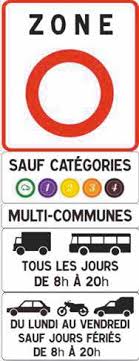
Low Emission Zones (LEZs) were created to protect residents of cities and metropolitan areas where air pollution is significant. Within an LEZ, only the least polluting vehicles (based on their Crit'Air sticker) are allowed to circulate. Municipalities determine the periods during which traffic is restricted, the types of vehicles affected (cars, trucks, etc.), and the minimum Crit'Air sticker level required to circulate (exemptions may apply; see the specific details on the metropolitan area's website).
- Around ten low-emission zones have already been created and implemented in cities with more than 150,000 inhabitants.
- By 2024, there are planned to be a total of 45 ZFE-m in France, always in cities with more than 150,000 inhabitants.
FATEC Group supports companies in their energy transition challenges:
- Employer Mobility Plan
- Sustainable Mobility Package
- Mobility Advice
- Fleet greening
- Support for the installation of charging stations.
Contact us.