

The electrification of light commercial vehicles requires companies to anticipate the need for on-site electric charging infrastructure.
Between autonomy constraints, tour schedules, available power on site and installation costs, there is no single solution that can be duplicated for all fleets of commercial vehicles.
The choice of charging station type depends primarily on the actual usage of the site and the available time for charging vehicles. This article provides a detailed overview of the different types of charging stations, the usage constraints for light commercial vehicles (LCVs), and the criteria to consider when choosing the right charging station for your specific needs.
What are the different uses and needs of light commercial vehicle (LCV) fleets?
Even though the use of commercial vehicles remains largely similar across sectors (services, goods transport, last-mile delivery, commercial uses), operational constraints vary considerably. That said, contrary to what one might expect, according to a study by ENEA Consulting, commercial vehicles travel an average daily distance of 123 km in most cases.
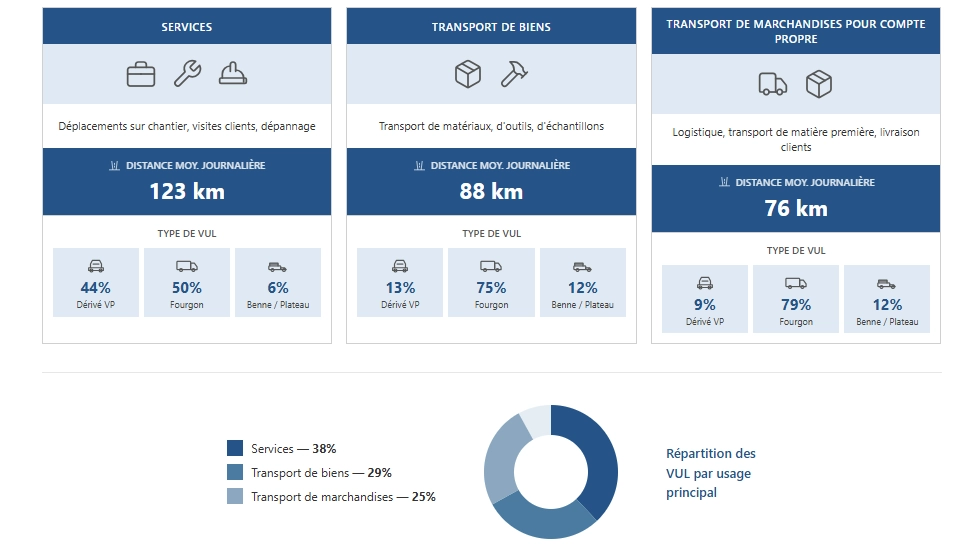
Source: What will light commercial vehicles be used for tomorrow? ENEA Consulting – April 2018
In most cases, commercial vehicle fleets follow predictable routes, with identifiable fuel consumption and regular returns to the same parking or depot location. This makes overnight on-site charging a priority. A study conducted by AVERE France confirms this, showing that overnight on-site charging will remain the dominant method in the coming years.
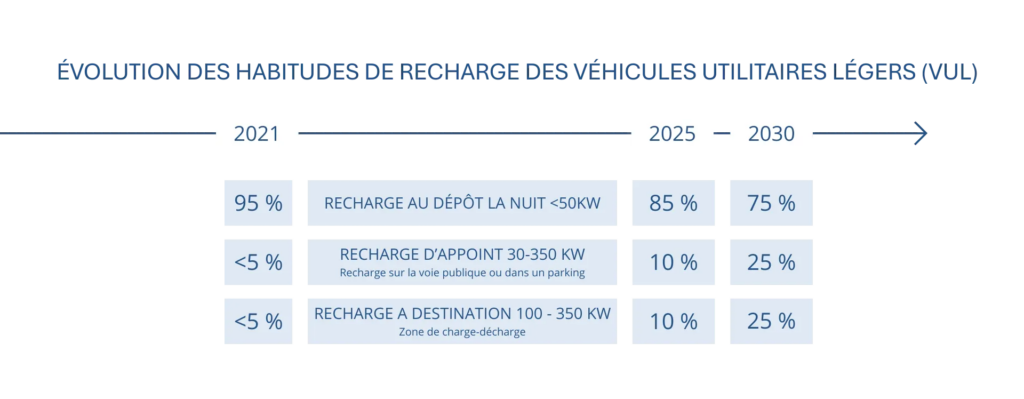
Source: Feasibility study on road transport charging infrastructure in France – ADVENIR study, led by AVERE France.
So what type of charging stations should you choose for your fleet of electric utility vehicles?
There are three types of charging stations, each meeting specific requirements for power and time needed to recharge vehicles.
What are the different types of terminals?
There are slow AC charging, accelerated AC charging, and fast DC charging. The difference lies in the type of current (alternating or direct) and the electrical supply available at your site (single-phase or three-phase).
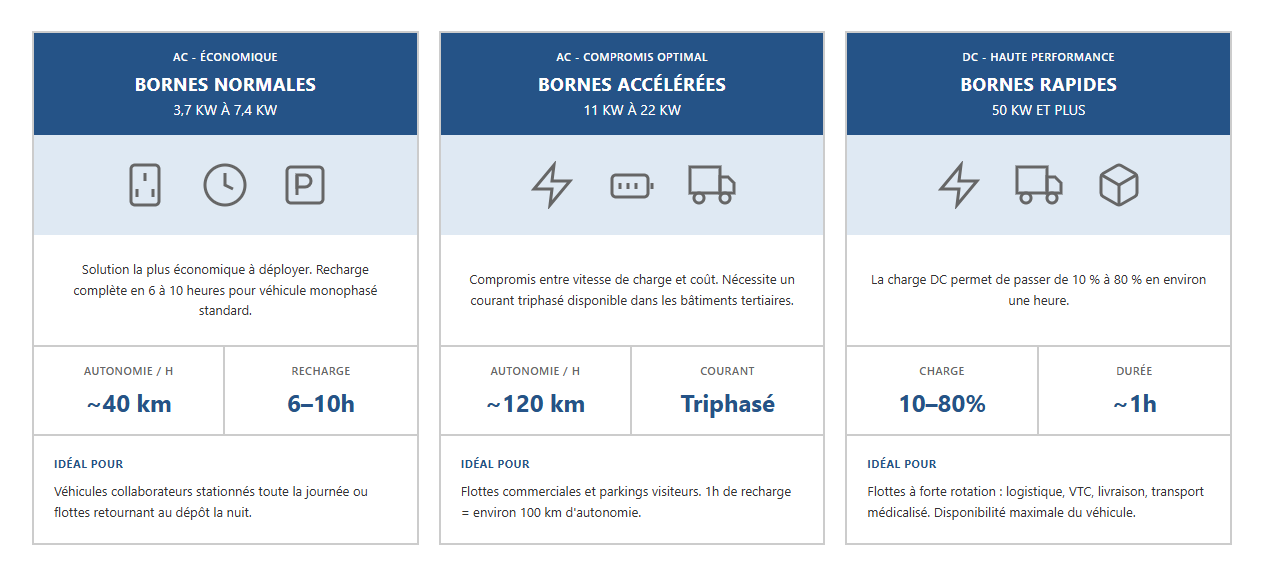
The choice of charging stations therefore depends essentially on the time your employees can devote to charging their vehicle, but also on the power that the vehicles can support (for example, an electric Renault Master accepts a maximum of 11 kW in AC and a maximum of 50 kW in DC).
Which charging stations are best suited to your fleet?
Standard AC charging stations (3.7 to 7.4 kW)
3.7 to 7.4 kW AC charging stations are the simplest and most economical solution.
If your site is single-phase, AC charging stations from 3.7 to 7.4 kW are the simplest and most economical solution for charging utility vehicles that spend the night at the depot and carry out local rounds during the day (deliveries, local interventions).
In practical terms, a 7.4 kW charging station allows an electric LCV to recover several tens of kilometers of range per hour and to recharge a 50 to 70 kWh battery, like that of a Citroën e-Jumpy, over a period of 6 to 10 hours.
For example, if vehicles systematically return to the site between 6 and 7 p.m. for a resumption of service at 6-7 a.m., this type of charging station is more than sufficient to refuel during the night.
These charging stations become particularly efficient when integrated into a smart charging system. Charging is then automatically shifted to off-peak hours, and the power is smoothed out to avoid overloading the site's electrical infrastructure.
“Fast” AC charging stations (11 to 22 kW)
11-22 kW AC charging stations represent the standard for a depot that operates an intensive fleet of electric LCVs (sustained routes, multi-use, multiple drivers per day).
They require a three-phase power supply, common in commercial buildings, warehouses, and logistics platforms. In return, they offer several key advantages for commercial vehicles. A light commercial vehicle can regain a significant portion of its range in 2 to 4 hours of charging, and recharging is compatible with periods of downtime during the day (loading, route planning, meal breaks).
Fast DC charging stations (50 kW and above) for high-turnover commercial vehicle fleets
Fast DC charging stations (DC ≥ 50 kW) are designed for light commercial vehicle fleets that require high vehicle uptime. This is the case, for example, for logistics and courier companies, breakdown service providers who sometimes need to intervene urgently, or passenger transport companies (private drivers, medical transport, etc.).
The advantage for a company of having fast DC charging stations (DC ≥ 50 kW) is that it allows vehicles to charge their batteries from 10% to 80% in about an hour, without immobilizing them for a significant portion of the day. This is the most practical solution for quickly regaining range, for example, during a charging/discharging operation or a break.
However, installing this type of charging station requires more significant investment. Before any implementation, it is essential to conduct a study of the electrical infrastructure. This may also involve creating a new delivery point, which must be requested from Enedis.
These charging stations also entail higher CAPEX and OPEX, as they are more expensive and generate additional construction costs. Therefore, in a commercial vehicle (CV) strategy, DC fast charging stations should be considered as strategic supplementary solutions, positioned where a few minutes of fast charging can save a delivery route (regional hub, central depot, site near a major transport route), and not as a "generic" solution to be deployed everywhere.
The key to successfully installing EV charging infrastructure for your fleet of commercial vehicles
Every fleet of light commercial vehicles is different and deserves a customized solution, perfectly adapted to its specific needs (route type, site size, seasonality, network constraints, etc.). The solutions we have presented (standard AC, accelerated AC, fast DC) provide the foundation for a better understanding of charging systems and the successful implementation of your project.
To successfully complete your project and secure your investment, the first step is to carry out an electro-compatibility study.
This audit allows you to:
- Check the available power and identify the optimal reinforcements
- Precisely size the number of charging points according to your LCVs and their rotation
- Analyze your actual usage patterns (parking times, frequencies, peak periods)
- Anticipate the evolution of your electrical fleet
When properly managed, it guarantees a sustainable and profitable investment, optimizing your costs and ensuring the availability of your fleet.
FATEC supports you in this electrical compatibility study and in defining a customized charging architecture for your fleet of LCVs.